
You open your property assessment notice and see a number that looks nothing like what your home would sell for. Maybe it’s lower than you expected. Maybe it’s higher. Then you check your tax bill and find a third figure. It’s natural to wonder which number is “right.”
Understanding assessed value vs market value in Wisconsin takes the confusion out of this. These two values are related, but they are not the same thing, and they serve different purposes. This guide explains what each one means, why they often differ, how they affect your property taxes, and what you can do if you think your assessment is off.
Quick Answer
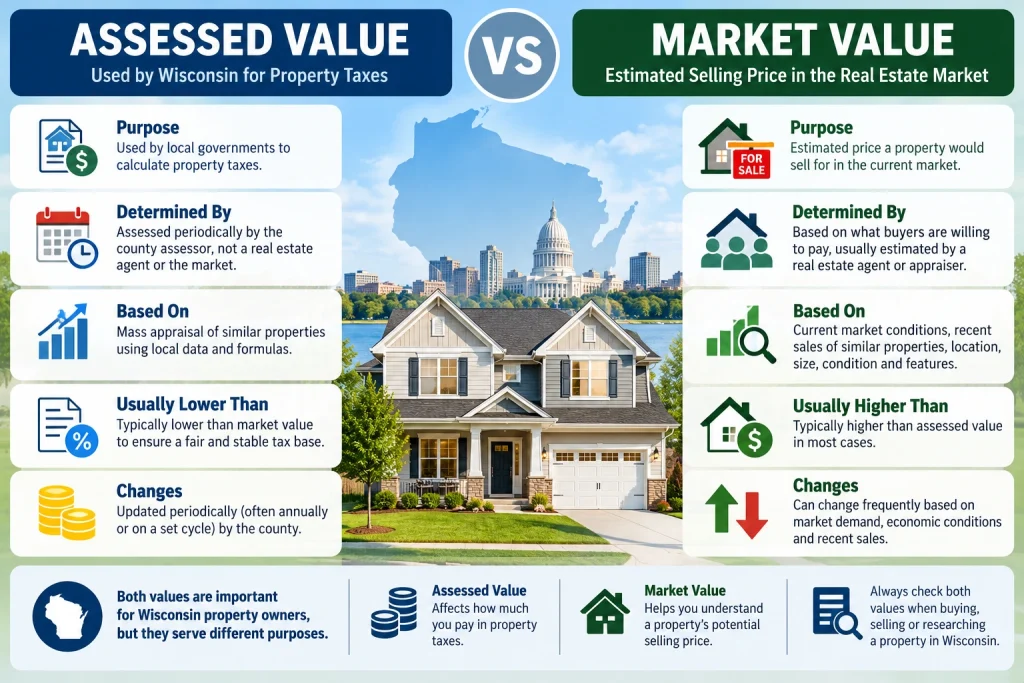
Market value is the price a property would most likely sell for in an open, competitive market. Assessed value is the value your local assessor assigns to the property to calculate property taxes. In Wisconsin, assessors are expected to assess property at or near full market value, but the two numbers can still differ because of timing, property condition, and the limits of mass valuation.
What Is Market Value?
Market value is what a willing buyer would pay and a willing seller would accept, with neither one under pressure. It is not set by any government office. The real estate market sets it, one sale at a time.
Several factors push market value up or down:
- Location and neighborhood
- Size, age, and condition of the home
- Lot size and land features
- Recent sales of similar nearby properties
- Interest rates and overall demand
- Upgrades such as a new kitchen or roof
Market value changes constantly. A home can be worth more this spring than it was last fall, and nobody officially records that change unless the property sells or is appraised.
What Is Assessed Value in Wisconsin?
Assessed value is the dollar amount your local assessor assigns to your property for property tax purposes. It is used to divide the tax burden fairly among all property owners in a taxing district, such as a city, village, town, or school district.
Wisconsin generally expects property to be assessed at full market value. In other words, the assessed value is meant to be the assessor’s best estimate of what your property would sell for. The assessor does not set your tax rate. The assessor only estimates value. Local governments, school districts, and other taxing bodies decide how much money they need to raise, and that determines the rate.
Because the assessor values thousands of properties at once, the process uses mass appraisal methods. These rely on sales data, property characteristics, and statistical models rather than a full inspection of every home.
Why Assessed Value and Market Value Can Still Be Different
Even when the goal is to match the market, the two figures rarely line up perfectly. Here are the most common reasons.
1. Timing
Your assessment reflects the market at a specific point in time. If home prices rise or fall after that date, your assessed value can lag behind. A home might sell for much more than its assessed value simply because the market moved after the last assessment.
2. Reassessment schedules
Not every municipality reviews every property every year. Some do full revaluations only periodically. In between, values may be updated only for new construction or major changes.
3. Property condition and interior details
An assessor may not see the inside of your home. A fully renovated kitchen or a home in poor condition may not be reflected in the assessment. Buyers will notice these things, and the sale price will reflect them.
4. The limits of mass appraisal
Mass appraisal is accurate on average, but individual properties can be over- or under-valued. Unusual properties, such as homes with unique features, waterfront land, or large rural parcels, are harder to estimate.
5. Different purposes
A market value or appraisal for a mortgage answers the question, “What would this sell for today?” An assessment answers the question, “What is this property’s fair share of the local tax base?” Different questions can lead to slightly different numbers.
Land Value vs Improvement Value
Your assessed value is usually split into two parts:
- Land value: the value of the lot itself.
- Improvement value: the value of buildings and other taxable improvements, such as the house, garage, or other structures.
Added together, they make up the total assessed value. Reviewing both numbers can help you spot problems. For example, if the improvement value looks too high for a small or older home, or the land value seems out of line with similar lots nearby, it may be worth a closer look.
What Is Equalized Value?
You may also see a third term: equalized value. This is an estimate of the full market value of all taxable property in a municipality, prepared each year by the Wisconsin Department of Revenue.
Equalized value is not your personal property value. It is a tool used to compare assessment levels across different municipalities and to help divide tax levies fairly among the taxing districts that overlap, such as a school district covering several towns. Think of it as a statewide yardstick, while your assessed value is the figure applied to your own property.
Your tax bill may also show an estimated fair market value. This figure is generally derived from your assessed value and local assessment level, so it is not the same as an appraisal or a sale price.
How Assessed Value Affects Your Property Tax Bill
Your property tax is calculated by applying a tax rate, often expressed as a mill rate, to your assessed value. One mill equals $1 of tax for every $1,000 of assessed value.
Hypothetical example (for illustration only):
| Item | Amount |
|---|---|
| Land value | $80,000 |
| Improvement value | $220,000 |
| Total assessed value | $300,000 |
| Example net tax rate | 17 mills ($17 per $1,000) |
| Estimated tax | $5,100 |
Calculation: $300,000 ÷ $1,000 × $17 = $5,100.
This is only an example. Real rates vary widely by municipality and school district, and credits can change your final bill. To see how rates differ across the state, check our Wisconsin Property Tax Rates by County page, or use the Property Tax Calculator for a quick estimate.
An important point: a higher assessment does not always mean a higher tax bill. If every property in your area is reassessed upward, the tax rate may fall, because the total amount that local governments need to raise stays about the same. What matters most is whether your property is assessed fairly compared with others.
Assessed Value vs Market Value: Side-by-Side Comparison
| Feature | Assessed Value | Market Value |
|---|---|---|
| Who determines it | Local assessor | The market (buyers and sellers) |
| Main purpose | Calculating property taxes | Buying, selling, financing |
| How often it changes | Depends on local reassessment practices | Can change constantly |
| Based on | Mass appraisal methods and sales data | Actual or likely sale price |
| Affects your tax bill | Yes, directly | Only indirectly |
| Can you negotiate it | Through the formal review process | Between buyer and seller |
How to Check Your Property’s Values Online
A good starting point is the property record for your parcel. With WI Parcel Search, you can look up Wisconsin parcels by parcel number, owner name, address, ZIP code, or city, and explore details such as estimated market value, land value, improvement value, and available property tax information.
To get started:
- Go to the WI Parcel Search home page and select your county. You can also browse the Counties Map or jump straight to a county page such as Dane County or Milwaukee County.
- Search by address or parcel number.
- Review the land value, improvement value, and total value shown.
- Compare them with your latest assessment notice and tax bill.
WI Parcel Search is an independent source and is not affiliated with any government agency. Records can lag behind or differ from official sources, so always confirm important details with your local assessor or county office.
What to Do If You Think Your Assessment Is Wrong
If your assessed value looks too high, you have options. Here is a general path, though you should always confirm the details locally.
- Review your assessment notice. Check the basics first: square footage, number of bedrooms and bathrooms, lot size, and property class. Simple data errors are common and easy to fix.
- Gather evidence. Collect recent sales of similar nearby homes, a recent appraisal if you have one, photos of defects or damage, and repair estimates.
- Talk to your local assessor. Many issues are resolved informally by showing the assessor the evidence.
- Use the formal review process if needed. Wisconsin municipalities have a Board of Review where property owners can formally object to an assessment. Deadlines and procedures can be strict. In some cases you must give advance notice or follow specific steps before the hearing. Contact your municipal clerk or assessor early to learn the rules for your area.
Keep in mind that the goal of an objection is not simply a lower number. It is a fair number compared with similar properties.
Common Mistakes and Misconceptions
- “My assessed value is my selling price.” It isn’t. Your home can sell for more or less than its assessed value.
- “A higher assessment always means higher taxes.” Not necessarily. The tax rate and the assessments of other properties matter too.
- “Buying a home automatically resets my assessment.” A sale price is useful evidence for the assessor, but the assessment is not automatically changed to match it.
- “The assessor sets my tax rate.” Taxing bodies set the levy and the rate, not the assessor.
- Missing the objection window. Waiting too long can cost you the chance to challenge an assessment for that year.
- Ignoring land and improvement values. Errors often hide in one part of the total.
Frequently Asked Questions
Is assessed value the same as appraised value?
No. An appraisal is an opinion of value prepared for a specific purpose, such as a mortgage loan. An assessment is the value assigned by the local assessor for property tax purposes. They can be close, but they are done by different people for different reasons.
Why is my assessed value lower or higher than what I paid?
Assessments reflect a point in time and use mass appraisal methods. If the market has moved since the assessment date, or if your property has features the assessor has not captured, the numbers can differ from your purchase price.
Does buying a home change my assessment?
A recent sale is strong evidence of market value, and assessors often use sales data. However, the assessment is not automatically set to your purchase price. Any change depends on your municipality’s assessment practices.
How often are properties reassessed in Wisconsin?
It depends on the municipality. Some update values regularly, while others conduct full revaluations only periodically. Contact your local assessor to find out the schedule for your area.
Can I challenge my assessment?
Yes. Property owners can start by speaking with the local assessor and may then use the formal Board of Review process. Deadlines and requirements are strict, so check with your municipal clerk early.
Where can I find my property’s assessed value?
You can find it on your assessment notice, your property tax bill, or your county’s property records. You can also explore parcel details through WI Parcel Search as a starting point.
Final Thoughts
Assessed value and market value are two different measures with two different jobs. Market value tells you what your property could sell for. Assessed value tells your local government how to share the tax burden fairly. The gap between them is normal, but a large or unexplained gap is worth investigating.
Your next step is simple. Look up your parcel, compare the values with your latest notice and tax bill, and contact your local assessor if something does not look right. If you want to estimate how a value change could affect your bill, try our Property Tax Calculator. Planning a purchase or sale? Our Transfer Fee Calculator can help you estimate related costs.
Disclaimer: This article is for general informational purposes only and is not legal, tax, or appraisal advice. Assessment rules, deadlines, and procedures vary by location and may change. Confirm details with your local assessor, municipal clerk, county office, or the Wisconsin Department of Revenue.