
Before buying a home, purchasing vacant land, opening a business, or planning a new building, it is important to understand how the property can legally be used. Wisconsin zoning codes explained in simple terms can help you identify potential restrictions before making a costly decision. Zoning rules can affect whether you can build a house, add a second dwelling, operate a shop, or develop farmland. However, Wisconsin does not use one universal zoning code for every property. Cities, villages, towns, and counties may adopt different district names and rules. This guide explains the main Wisconsin zoning districts, common code examples, and how to verify the rules that apply to a specific parcel.
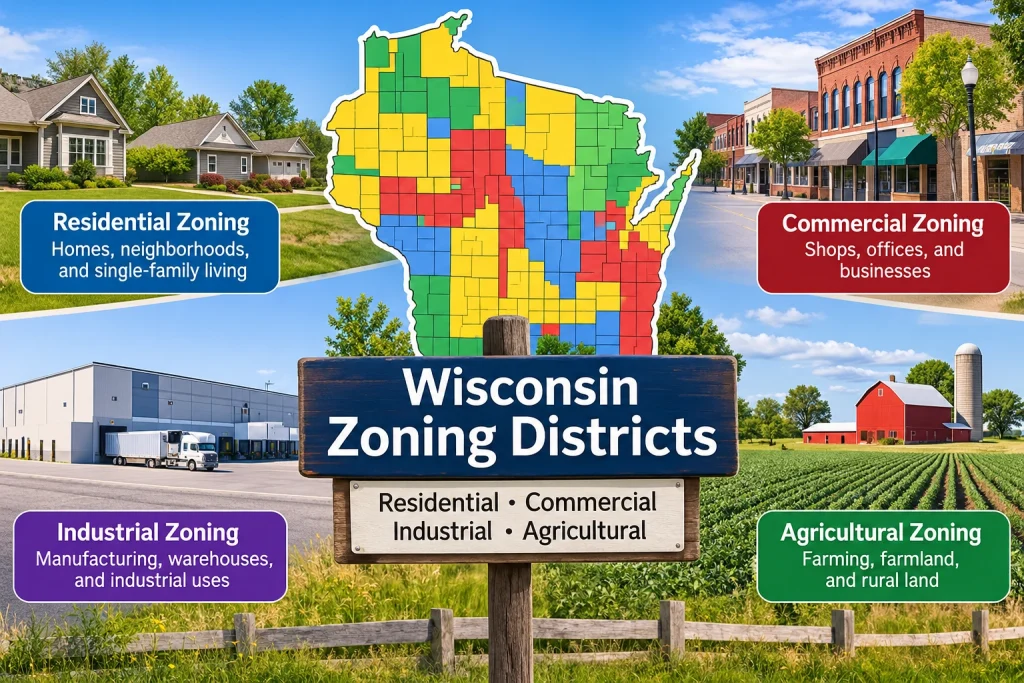
1. What Is Zoning, and Who Controls It in Wisconsin?
Zoning is a system of local land-use rules that determines how property may be developed and used. It divides an area into districts and establishes rules for activities such as housing, retail businesses, manufacturing, farming, and other uses.
In Wisconsin, zoning authority is exercised by local governments under applicable state law. Depending on the property’s location, zoning may be administered by a city, village, town, or county. The responsible authority and the rules that apply can differ between incorporated communities and unincorporated areas.
For example, a parcel outside a city’s boundaries may fall under county or town zoning arrangements. A parcel inside a nearby city may follow that city’s zoning ordinance instead.
Local zoning ordinances typically address:
- Allowed uses: Activities permitted within a district.
- Conditional or special uses: Activities that may require additional review and approval.
- Lot size and dimensions: Minimum lot area, width, or other requirements.
- Setbacks: How far a building must stand from property lines, roads, or other features.
- Building height and density: Limits on building size or the number of homes allowed.
- Site development: Requirements for parking, landscaping, access, and other improvements.
These rules form an important part of Wisconsin land use regulations. A zoning map shows the district assigned to a property, while the zoning ordinance explains what that district permits.
2. Why Zoning Matters for Property Owners and Buyers
A property’s location, price, and physical condition do not tell you everything about how you can use it. Zoning can affect its practical value and future development options.
Understanding the zoning classification before purchasing can help you:
- Determine whether your intended use is allowed.
- Check whether you can add a garage, accessory building, or second dwelling.
- Identify restrictions that may affect rental or business plans.
- Estimate whether a development idea needs additional approvals.
- Avoid buying land that cannot be used for your intended purpose.
Example: Suppose you purchase a rural parcel hoping to build a second house for a family member. The property may be large enough, but its zoning district could limit the number of principal dwellings, require a minimum lot area, or impose other conditions.
Similarly, a home buyer planning to operate a small retail shop from a garage should check whether the proposed activity is allowed in the residential district.
Zoning is only one part of property due diligence. Buyers should also investigate access, utilities, building permits, easements, environmental restrictions, and other factors relevant to their plans.
3. Residential Zoning Districts in Wisconsin
Residential zoning generally focuses on housing. The specific districts available and the uses permitted within them depend on the local ordinance.
Single-Family Residential Zoning
Single-family districts generally accommodate detached homes intended for one household. They may also allow certain accessory structures, such as garages or sheds, subject to local requirements.
Common example labels include R-1 and RS, but neither label has a single statewide definition.
Two-Family Residential Zoning
Two-family districts may permit duplexes or other housing arrangements defined by the local ordinance. Some communities allow duplexes in certain residential districts, while others require a different classification or additional approval.
An R-2 label is sometimes used for two-family or lower-density residential development, but its meaning must be checked locally.
Multifamily Residential Zoning
Multifamily districts generally accommodate apartments, condominiums, or other residential buildings with multiple dwelling units. Local rules may distinguish between smaller apartment buildings and larger developments.
An R-3 label may identify a multifamily district in some communities. Elsewhere, it may have a different meaning or not exist at all.
What Does R-1 Zoning Mean in Wisconsin?
R-1 commonly refers to a single-family residential district, but R-1 is not a uniform statewide zoning classification.
One municipality may permit accessory dwelling units under certain conditions, while another may restrict additional dwellings or impose different lot-size and setback requirements.
Before buying a property labeled R-1, review the local ordinance for permitted uses, conditional uses, building standards, and any additional restrictions.
4. Commercial Zoning Districts in Wisconsin
Commercial zoning generally accommodates businesses that provide goods or services. Local ordinances often separate smaller neighborhood businesses from larger retail or commercial operations.
Neighborhood Business Districts
Neighborhood business districts typically serve nearby residents. Depending on local rules, permitted uses may include small offices, personal services, convenience stores, or other low-impact businesses.
These districts may include limits on signage, operating activities, parking, building size, or hours of operation.
General Commercial Districts
General commercial districts may accommodate a broader range of businesses, such as retail stores, restaurants, professional offices, and service establishments.
More intensive activities may require conditional approval or a different district.
Downtown or Central Business Districts
Downtown districts are often designed for a mix of shops, offices, restaurants, services, and, in some communities, housing above commercial spaces.
Building design, pedestrian access, parking arrangements, and historic district requirements may influence development.
Codes such as B-1, B-2, and C-1 are common examples in some zoning systems, but their definitions vary. A B-1 district might represent neighborhood business in one community and a different commercial category elsewhere.
Example: If you plan to open a small bakery on a residential street, do not assume the activity is permitted because the business is small. Check whether the ordinance allows retail sales, food preparation, customer visits, and the required parking in that location.
5. Industrial Zoning Districts in Wisconsin
Industrial zoning generally accommodates manufacturing, warehousing, distribution, fabrication, and related activities. Local governments may separate industrial uses according to their potential effects on nearby properties.
Light Industrial Zoning
Light industrial districts may permit activities such as small-scale manufacturing, assembly, equipment services, workshops, or warehousing.
These uses can still produce noise, deliveries, traffic, or other impacts, so local standards remain important.
Heavy Industrial Zoning
Heavy industrial districts may accommodate more intensive manufacturing, processing, storage, or similar operations, subject to the applicable ordinance and environmental requirements.
A use that is acceptable in a heavy industrial district is not automatically allowed in a light industrial district.
Common Industrial Zoning Codes
Examples include M-1, M-2, and I-1. In some communities, M stands for manufacturing and I stands for industrial. The precise permitted uses and intensity limits depend on local definitions.
If you are considering a workshop, warehouse, or manufacturing property, check more than the district label. Review operating limits, outdoor storage rules, truck access, noise restrictions, and any separate environmental permits that may apply.
6. Agricultural and Rural Zoning Districts in Wisconsin
Agricultural zoning is intended to support farming and other compatible rural land uses. Depending on the local ordinance, permitted activities may include crop production, livestock operations, farm buildings, and certain related uses.
Common Agricultural Zoning Codes
A-1 and A-2 are examples of agricultural district labels used by some local governments. They do not have universal meanings across Wisconsin.
One district might emphasize agricultural production, while another might allow a broader mix of rural uses. Some districts also regulate residential development, minimum parcel sizes, or the division of farmland.
Farmland Preservation Zoning
Wisconsin has a farmland preservation zoning program administered through local ordinances and the state’s Department of Agriculture, Trade and Consumer Protection (DATCP). These districts aim to support agricultural activity, limit incompatible development, and help preserve farmland.
Certified farmland preservation zoning must meet applicable state requirements, and local ordinances may be more restrictive. Certain eligible landowners may qualify for farmland preservation tax credits if they meet the program’s requirements.
A county farmland preservation plan is not the same as a farmland preservation zoning district. A plan can guide future land-use decisions without imposing restrictions on its own.
Before buying agricultural land, confirm whether the property is subject to farmland preservation zoning and whether your intended house, business, subdivision, or other project is permitted.
7. Other Wisconsin Zoning Districts and Restrictions
Not every property fits neatly into a residential, commercial, industrial, or agricultural category. Other districts and regulatory overlays may affect development.
Conservation and Natural Resource Districts
These districts generally aim to protect sensitive land, natural resources, open space, or environmentally important areas. Building and land-clearing options may be limited.
Shoreland and Shoreland-Wetland Zoning
Properties near lakes, rivers, and other navigable waters may be subject to shoreland or shoreland-wetland rules. These requirements can affect vegetation removal, building setbacks, lot development, and other activities.
Wisconsin’s shoreland program includes statewide minimum standards administered through local ordinances. The applicable requirements depend on the property’s location and circumstances.
Floodplain Zoning
A parcel in a mapped floodplain may face restrictions on new construction, building alterations, grading, or other development. Check applicable local floodplain ordinances and current floodplain maps before making plans.
Institutional Zoning
Some communities establish districts or specific rules for schools, hospitals, government facilities, religious institutions, or other public and institutional uses.
Planned Development and Mixed-Use Districts
Planned development districts may allow a project to be reviewed under an approved site plan or a set of project-specific conditions. Mixed-use districts may combine housing, shops, offices, or other compatible uses.
These categories are not interchangeable. A parcel’s base zoning may operate alongside shoreland, floodplain, wetland, or other applicable requirements. Always check for overlapping restrictions.
8. Why Zoning Codes Differ Between Wisconsin Communities
One of the most important points in understanding Wisconsin zoning classifications is that code names are local, not statewide definitions.
The label R-1, B-1, M-1, or A-1 is only a starting point. Its meaning comes from the ordinance that applies to the specific property.
For example, two parcels may both carry an R-1 label. The first community might allow only detached single-family homes, while the second might permit certain additional residential uses under specified conditions.
Even properties within the same county may be subject to different rules if they fall under different zoning authorities.
To interpret a code correctly, identify:
- The property’s actual zoning jurisdiction.
- The district name and code on the current zoning map.
- The applicable ordinance and its use tables.
- Any conditional-use requirements or overlapping restrictions.
- Whether a recent rezoning or ordinance amendment affects the parcel.
Do not rely on a zoning label found on an old listing, an unofficial map, or another property’s records without confirming the current classification.
9. Quick Comparison of Wisconsin Zoning Districts
The following table provides general examples only. These codes, permitted uses, and restrictions are illustrative, not official statewide definitions.
| District Type | Example Codes | Typical Uses | Possible Restrictions |
|---|---|---|---|
| Residential | R-1, R-2, R-3 | Houses, duplexes, apartments, depending on district | Dwelling density, setbacks, lot size, building height |
| Commercial | B-1, B-2, C-1 | Shops, offices, restaurants, services | Parking, signage, operating activities, building size |
| Industrial | M-1, M-2, I-1 | Workshops, manufacturing, warehouses | Noise, outdoor storage, traffic, permitted industrial intensity |
| Agricultural | A-1, A-2 | Farming, farm buildings, certain rural uses | Nonfarm development, lot division, residential density |
| Conservation | Local codes vary | Open space, resource protection, certain low-impact uses | Building, clearing, or development limits |
| Mixed-use or planned development | Local codes vary | Combinations of residential and commercial uses | Approved plans, design conditions, use-specific standards |
A property’s actual permitted uses and development limits must be determined from the applicable local ordinance and any other rules that govern the site.
10. How to Check a Property’s Zoning in Wisconsin
You can use online parcel records to begin your research, but the local zoning authority should confirm the rules before you commit to a purchase or project.
Step 1: Find the Property Parcel
Start with the property’s street address, parcel identification number, or county property search. If you do not know the parcel number, use the address to locate the property.
You can begin with WI Parcel Search, an independent resource for researching parcels across Wisconsin’s 72 counties. Its parcel details and available zoning or classification information can serve as a starting point for your research, but you should verify important information with the responsible local government.
You can also explore the Wisconsin counties map to identify the county where a property is located.
Step 2: Review the Parcel’s Available Information
Look for the parcel’s location, property classification, and any available zoning details. County property records may help you identify the land, but tax classifications and zoning classifications are not necessarily the same.
For additional research, see the Dane County property search or Milwaukee County property search.
Step 3: Find the Official Zoning Map
Locate the zoning map maintained by the city, village, town, or county responsible for the property. Confirm the district assigned to the exact parcel rather than relying only on nearby properties.
If the map is unclear or the property lies near a jurisdictional boundary, contact the zoning office for assistance.
Step 4: Read the Zoning Ordinance
Find the ordinance section for the property’s district. Review the permitted-use table, conditional uses, dimensional standards, and relevant development requirements.
Look specifically for rules affecting your plans, such as the minimum lot area for a second home or whether customer visits are allowed for a home business.
Step 5: Ask for Confirmation Before Acting
Contact the local zoning administrator or planning department. Explain the property and your intended use, and ask whether the activity is allowed and what approvals may be required.
For a major purchase or development, request written confirmation when possible. Ask whether any proposed changes, pending applications, or additional land-use restrictions could affect the project.
11. Common Zoning Mistakes Property Buyers Make
Even experienced buyers can overlook zoning details. These are some common mistakes to avoid.
- Assuming the same code means the same thing everywhere. R-1 or A-1 can have different definitions in different jurisdictions.
- Confusing tax classification with zoning. A property-tax category does not establish every use allowed under a zoning ordinance.
- Assuming vacant land is automatically buildable. Lot dimensions, access, utilities, wetlands, floodplains, and other requirements may affect development.
- Assuming existing use means future use is permitted. An existing business or building may have legal nonconforming status or separate approvals that do not automatically transfer to a new use.
- Treating a conditional use as an automatic right. Additional review, conditions, or approval may be required.
- Ignoring restrictions outside the zoning district. Shoreland, floodplain, environmental, subdivision, and building requirements can affect what you can do.
- Assuming rezoning will be approved. A request to change zoning is subject to the applicable review and decision process. Approval is not guaranteed.
Before estimating the cost of a property purchase, consider other expenses as well. WI Parcel Search offers tools for researching property tax rates by Wisconsin county, estimating taxes with the Wisconsin property tax calculator, and estimating transfer-related costs using the transfer fee calculator. These tools support financial research; they do not replace zoning verification.
12. Frequently Asked Questions About Wisconsin Zoning Codes
What Does R-1 Zoning Mean in Wisconsin?
R-1 commonly identifies a single-family residential district, but its exact meaning depends on the local zoning ordinance. Rules for accessory buildings, additional dwellings, minimum lot sizes, and other uses may differ. Check the official zoning map and ordinance for the property’s jurisdiction before relying on the label.
Can I Run a Business From a Residential Property in Wisconsin?
Possibly. Some communities allow home-based businesses under specific conditions, while others restrict certain activities or require additional approval. Customer traffic, employees, signs, deliveries, noise, and the type of business can affect eligibility. Contact the local zoning office before opening or expanding a business at a residential property.
Can Zoning Change After I Buy a Property?
Yes. Local governments can amend zoning ordinances or maps through applicable procedures. A property’s zoning may therefore change after purchase. If you are concerned about a proposed development or future land-use changes nearby, ask the local planning department about pending zoning amendments, development applications, and adopted plans.
What Is a Zoning Variance in Wisconsin?
A variance is a form of relief from a specific zoning requirement when the applicable legal standards are met. It is not a general permission to use land for any purpose. The local zoning board or other authorized body reviews the request under the applicable rules. A variance and a rezoning are different processes.
Who Do I Contact to Confirm a Property’s Zoning?
Contact the zoning administrator or planning department responsible for the property’s location. Depending on the jurisdiction, this may be a city, village, town, or county office. Provide the address or parcel number and describe your intended use. Ask for the applicable zoning district, ordinance provisions, and any additional approvals required.
Does Agricultural Zoning Mean I Can Build a House on the Property?
Not necessarily. Agricultural districts may restrict residential development or impose minimum parcel sizes, dwelling limits, or other conditions. Farmland preservation zoning can add further restrictions on nonfarm uses. Check the local ordinance and determine whether the proposed dwelling is permitted or requires additional approval before purchasing land.